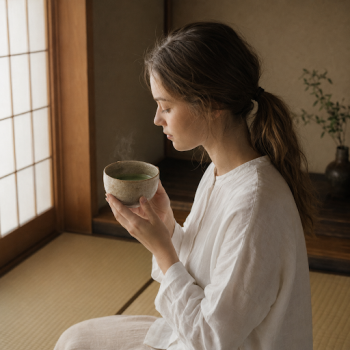
As a writer and essayist, my life has long been spent shaping words and observing the quiet contours of the world. Yet this marks the very first entry of this journal—a beginning from my hearth. Living across England and Japan, perhaps the most profound wisdom I have gathered does not come from grand philosophies, but from the everyday art of preserving tranquility. In particular, it was through the study of tea that I discovered how the gentle discipline of form—the unhurried, physical rhythms of daily habit—can safeguard an enduring, quiet life.
The Labor of Dawn: Sweeping Before the Hearth
In traditional Japanese households, the day did not begin with idle discussion; it began with two unhurried physical tasks: the sweeping of the house and the preparation of a single bowl of matcha. This pattern was not devised as an abstract theory, but as a practical rhythm of daily life passed down through generations.
There are mornings when a person’s surroundings feel cluttered. A stray conversation from the previous day or the tasks awaiting the afternoon can easily fill the early hours. Yet within traditional daily life, people did not attempt to argue with these thoughts or force their moods to change. They simply allowed whatever was present to remain, and let their hands begin the work of the day.
Long before the iron kettle was placed over the charcoal, the routine started outside. The stone threshold and the garden path were swept with a bamboo broom. Inside, the wooden floors were wiped with a simple damp cloth until the cedar boards showed their natural grain. One swept the fallen pine needles not to ponder great ideas, but simply because the needles were on the ground. It was physical, repetitive work done with the hands and arms, requiring no spoken words.
The Iron Kettle and the Rhythm of the Whisk
Only when the space was swept clean did one sit upon the woven tatami before the iron kettle.
The preparation of morning matcha in this tradition is a matter of practical repetition rather than rigid concentration. One does not need to brace oneself to whisk tea. Because the physical movements—measuring the water with a bamboo ladle, warming the ceramic bowl, and whisking the green powder—have been repeated countless times, the body handles the utensils with natural ease.
The bright jade tea mixes with the hot well water. The crisp sound of the bamboo whisk echoes against the clay bowl. The thoughts of yesterday may still exist somewhere in the room, but the hands remain occupied with the ladle, the bowl, and the steam.
An Unadorned Vessel for the Day Ahead
By the time the bowl is finished and set down, the morning has quietly moved forward. Nothing about yesterday’s events has been rewritten, yet the room is swept, the tea utensils are wiped dry, and the household is ready for the day ahead.
This is the quiet simplicity of the morning tea bowl. It is not an abstract theory, but the plain, enduring habit of setting a broom to the floor and whisking a bowl of tea before the rest of the world begins to stir.

Comments