
Carried by research for my writing and a dream held since high school to experience the world firsthand, I have lived across cities around the globe.
Moving between these diverse places, a cashmere wrap has become my constant companion—indispensable both in transit and in the quiet rhythms of daily life.
It was right by my side throughout my travels in the South Island as well, which I shared in my notes on Slow Days in New Zealand: Reflections on Quiet Luxury Travel and Rural Stillness.
Today, I want to share why I love this single piece of cloth so deeply, and how it has earned its enduring place in my life across fifteen distinct reasons.

- Part I: 15 Reasons to Invest in One
- Part II: A Personal Memory: Christchurch Winters and a Decade of Care
- Part III: In the Boutique: Guiding Points and the Intuition of Touch
- Part IV: The Buyer’s Guide: Anatomy, Comparisons, and Versatility
- Part V: The Geography of Fiber: Origins, Steppe Winds, and Craft Heritage
- Part VI: A Life Lived with Cashmere: The Grace of Everyday Rhythms
- Part VII: The Curated Directory: Fiber Grades, Palettes, and Global Makers
- Authoritative Standards & Fiber Resources
Part I: 15 Reasons to Invest in One
The Architecture of Transit
1. The In-Flight Personal Cocoon
Airline cabins are notoriously unpredictable microclimates, shifting from stifling tarmac heat to freezing drafts at cruising altitude. Rather than relying on thin, synthetic airline blankets of questionable cleanliness, a generous wrap envelopes your shoulders and torso in breathable warmth that regulates temperature naturally.
2. Instant Lumbar Support and Headrest
Long-haul train compartments and economy seating often lack ergonomic contouring. Folded into a neat oblong or rolled into its dedicated pouch, a dense 2-ply cashmere wrap transforms into a resilient lower-back cushion or a soft headrest against a vibrating window pane.
3. Zero-Pressure Sleep Mask
Standard eye masks with tight elastic bands often leave marks across the temples and place pressure on the eyelids. Draping a soft cashmere edge loosely over the upper half of your face blocks cabin lighting completely while allowing the skin to breathe.
4. Bridging 20-Degree Swings
Stepping from an air-conditioned airport terminal directly into the humid evening heat of Southern Europe or the subtropics is jarring. Cashmere breathes instantly; it insulates against the chill indoors without feeling suffocating the moment you step outside into the open air.
5. Featherweight Packing Efficiency
A heavy knit sweater or structured wool jacket consumes substantial volume inside a weekender bag. A finely woven cashmere wrap delivers equal warmth while rolling down to roughly the size of a paperback book, tucking effortlessly into the corner of any daypack or tote.
Presence and Daily Utility
6. The Immediate Evening Dress-Up
Travel often means walking through rain and cobbled streets in daytime essentials—linen trousers, a relaxed tee, or broken-in denim. Throwing a generous cashmere wrap across the shoulders with a relaxed, asymmetric drape instantly elevates daytime basics into an appropriate ensemble for an understated dinner or the theatre.
7. Respectful Coverage for Sacred Spaces
Visiting historic basilicas in Rome, tranquil stone temples in Kyoto, or quiet rural chapels requires covered shoulders and modest silhouettes. Keeping a wrap folded in your day bag ensures you are never caught unprepared at sacred architectural entrances.
8. The Unrushed Morning Terrace Ritual
Before the day begins, sitting on a hotel balcony or outside a countryside cottage in the crisp morning air requires just enough warmth to linger. Slipping a wrap over nightwear allows you to enjoy a slow pot of tea or coffee while watching the fog lift from the garden.
9. Four Distinct Ways to Wear
A travel wrap is never a single-purpose garment. It functions as a classic looped neck scarf, an asymmetrical shoulder throw, a belted poncho pinned gently at the waist, or an insulated snood tucked closely under an unbuttoned trench coat.
10. Draft Defense Without Stiff Bulk
Open-window coastal trains, windy ferry crossings, and drafty outdoor dining terraces all expose the vulnerable neck and collarbone. The fluid drape of cashmere settles seamlessly around the collar without the stiff, restrictive bulk of heavy wool scarves.
The Quality of the Object
11. Self-Restoring Natural Elasticity
Natural animal fibers possess an inherent memory. After hours of being folded, sat on, or crumpled inside a bag, a cashmere wrap requires neither an iron nor a garment steamer. Hanging it inside a hotel bathroom while taking a hot shower allows the rising steam to relax every fold within fifteen minutes.
12. Inherent Odor Resistance
Unlike synthetic fleeces that trap perspiration and develop stale smells during travel, natural cashmere fiber scales resist bacterial accumulation. It does not require frequent washing; simply hanging it on a wooden chair near an open window overnight completely refreshes the cloth.
13. Freedom from Hardware and Visible Branding
True quiet luxury relies on fiber micron count, weave density, and tactile weight rather than hardware, zippers, or oversized monograms. A neutral wrap—in oat, slate grey, heather navy, or soft black—complements every color palette you pack without competing with the rest of your wardrobe.
14. Sensory Grounding on Overstimulating Days
Delays, crowded boarding gates, and lost train connections can exhaust the nervous system. The physical touch of superfine, 15-micron cashmere against the skin provides an immediate tactile comfort that grounds the senses amidst the clamor of transit.
15. The Catalyst for Traveling Carry-On Only
By replacing bulky extra sweaters, two scarves, an extra cardigan, and a travel pillow with one single piece of cloth, you remove the necessity for a second piece of luggage. It is the single investment that makes traveling unburdened a practical reality.
Part II: A Personal Memory: Christchurch Winters and a Decade of Care
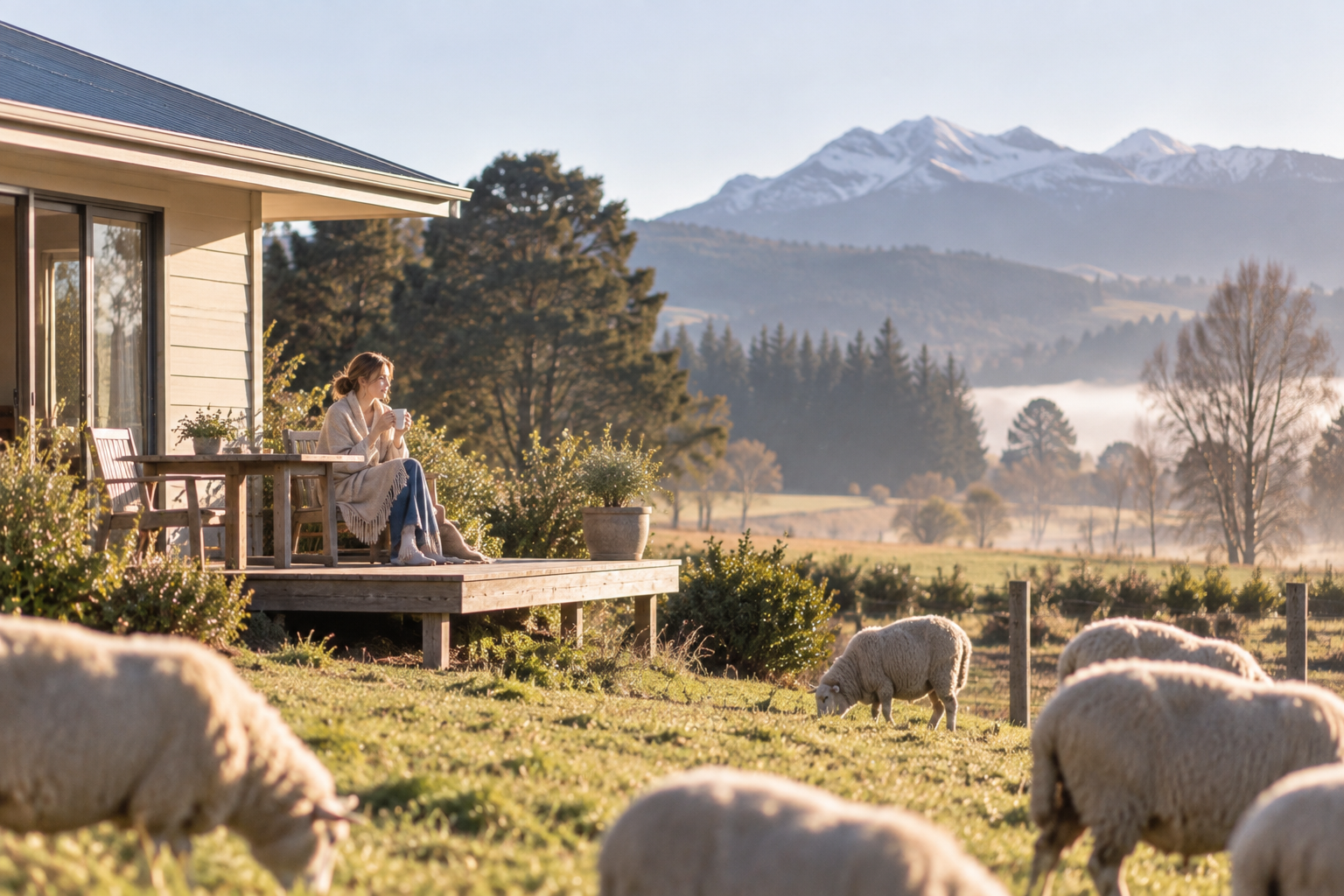
I acquired my very first cashmere wrap years ago in New Zealand.
New Zealand is not a land that produces cashmere; its rolling hills are famously the domain of fine merino sheep. Yet anyone who has spent a winter season in the South Island—particularly in Christchurch—knows a distinct kind of penetrating chill that seeps upward from the ground.
While clear midday hours can bring unexpected warmth, the mornings remain bitterly cold until around nine o’clock, and the temperature drops precipitously the moment the late-afternoon shadows lengthen across the Canterbury Plains.
It was during those severe shifts that I discovered what this single piece of cloth could do. Draping it loosely over my shoulders brought an immediate, gentle warmth that felt entirely alive—a natural insulation that does not trap stale heat, but softens the spirit from within.

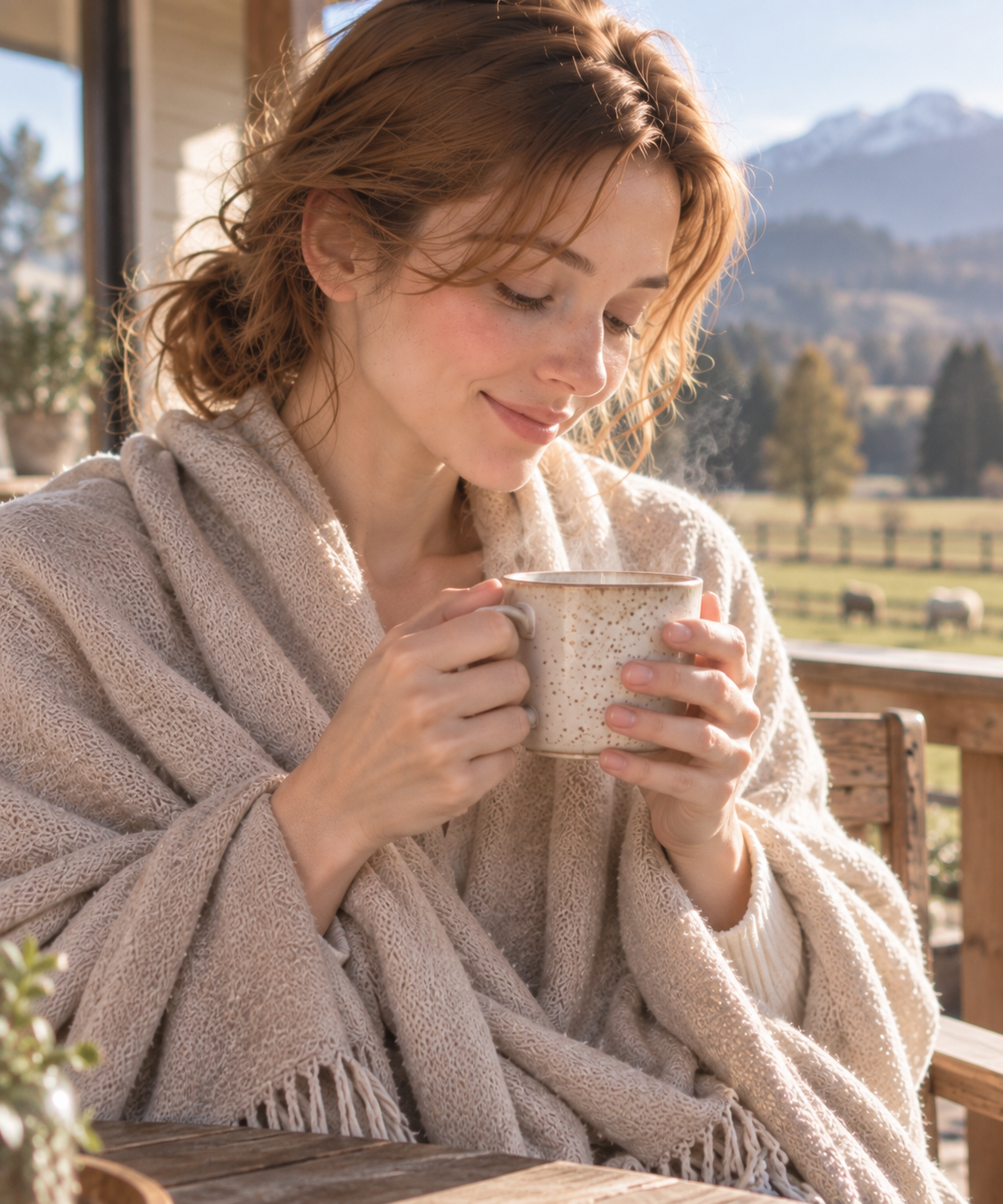
I still vividly recall sitting on the wooden terrace of my homestay house in the quiet twilight of Christchurch, wrapped in that soft cloth with a steaming mug of black coffee in hand, watching the dusk settle over the garden.
At the time, as a young student, investing in such a fine piece felt like an immense, slightly terrifying leap. Yet looking back across all these years, it remains one of the wisest purchases I have ever made.
That very same wrap has accompanied me across the globe ever since, aging gracefully across a decade of departures and arrivals. High-quality pieces like this truly last ten, even twenty years.
True luxury in natural fibers reveals itself in their resilience, a phenomenon many of you have likely experienced with your own cherished clothes. An honest woolen or cashmere garment rarely demands frequent, harsh chemical dry cleaning—a process I personally prefer to avoid whenever possible.
Instead, whenever mine feels in need of a refresh after days on the road, I simply lay it across a sunlit terrace chair for a little while or let it breathe in the gentle outdoor air.
Just a short time resting in the natural light leaves the fabric completely refreshed and renewed, without the slightest damage or wear. Handled with simple attentiveness, a fine wrap asks for neither coddling nor excess; it simply endures, quiet and unchanged, ready for the next journey.
Part III: In the Boutique: Guiding Points and the Intuition of Touch

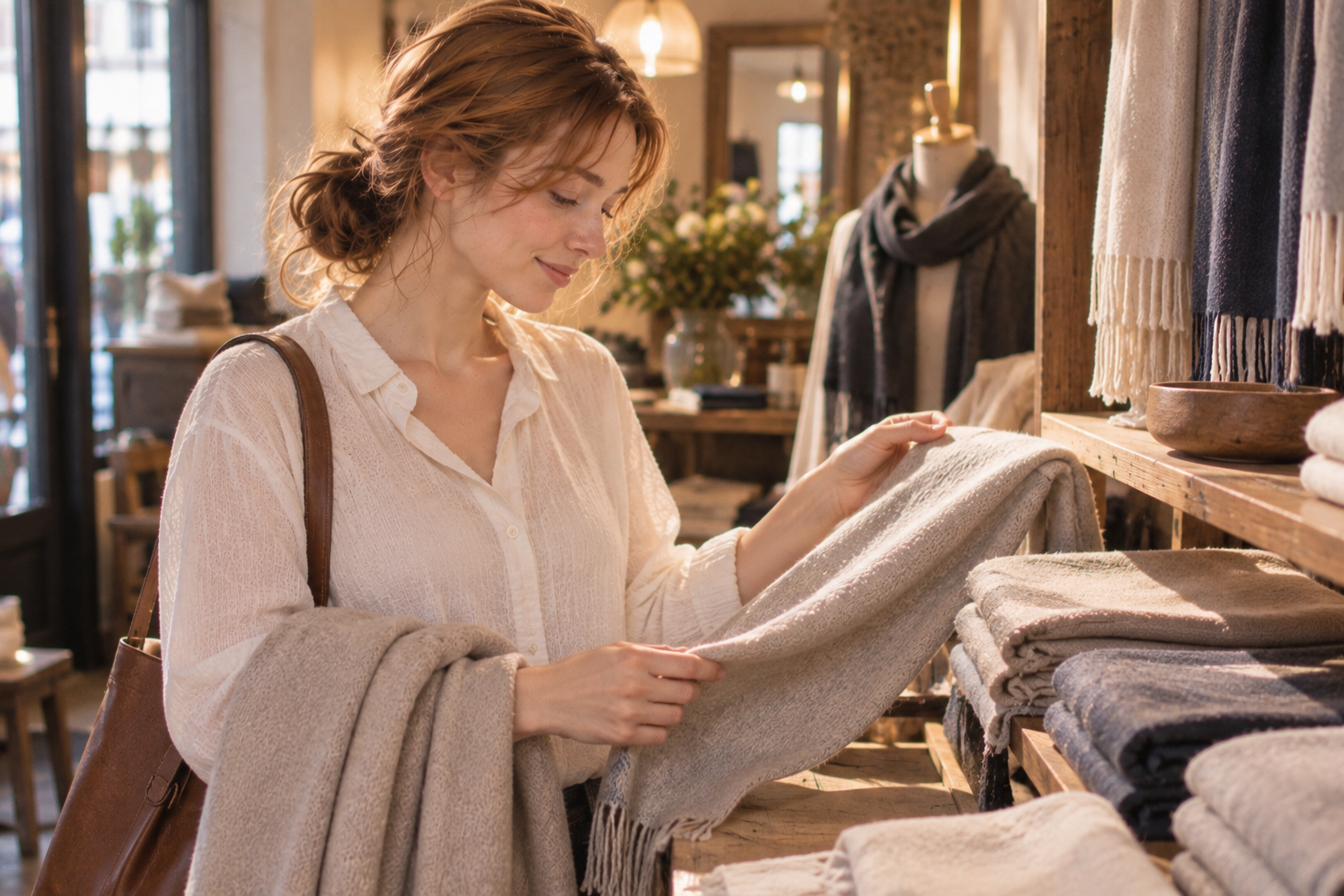
Standing before a display of cashmere wraps, selecting the piece that will accompany you across seasons becomes a delightful study in personal style, tactile beauty, and thoughtful craftsmanship. Here are practical markers to consider in the shop:
1. Choosing the Palette That Reflects Your Journey
Every shade brings its own distinct grace to travel:
- Heathered & Melange Neutrals (Oatmeal, Slate, Taupe): Knitted from yarns blending subtle tonal variations, these gentle shades bring a relaxed, organic warmth that pairs effortlessly with denim, natural linen, and casual knitwear.
- Classic Black & Deep Navy: The epitome of timeless sophistication. A dark wrap instantly sharpens any silhouette, seamlessly transitioning from long flights to elegant evening dinners and formal city settings.
- Soft Ivory & Pale Cream: Luminous and uplifting, these light tones bring a radiant glow to your complexion, reflecting soft morning light beautifully whether at an outdoor café or on a coastal train.
2. The Fluid Beauty of a Knitted Drape
While crisp woven stoles offer a lovely architectural structure, a fine-gauge knitted wrap possesses a gentle, living stretch. It drapes naturally over the collarbones, easily gathers into an effortless loop, and compresses softly into a carry-on tote without resistance. Look for finished borders—such as a fine ribbed hem or an understated rolled edge—which lend a clean, tailored finish to the drape.
3. The Promise of Resilience and Bloom
Quality cashmere possesses a quiet substance. When touching the wrap, seek out a piece that feels smooth against the neck while offering a supple, resilient spring between your fingertips. The finest long-staple fibers are designed to “bloom”—becoming noticeably softer and more tender with each wear and gentle airing, growing more luxurious over the years.
4. The Versatility of the Oblong Silhouette
An elongated rectangular cut (roughly 75 to 81 inches in length by 32 to 36 inches in width) provides the greatest styling freedom. This generous proportion allows the fabric to spread wide as a serene shoulder throw during chilly mornings, yet gathers compactly enough to wind twice around the throat as a cozy, protective scarf when walking against the wind.
The Intuition of Touch: Trusting What Feels Like You
When shopping for clothes, many of us have had the experience of looking back at our wardrobe and realizing that the pieces we truly reach for are simply the ones that felt right from the very beginning. I find this to be true every time I choose clothing.
Standing in a shop, one can easily get lost in intellectual calculations—wondering whether a piece can be worn to a party, or how it might coordinate with different outfits on an upcoming trip. We deliberate over functions and multiple occasions.

Yet in the end, the very best choices come from simply picking up a piece, touching the fabric, placing it against your body, and realizing that it feels completely natural and comfortable.
It is that inner sense of “I truly love this” that makes a selection succeed. Throughout all my travels and wardrobe decisions, trusting that physical, intuitive feeling has never steered me wrong. Technical versatility has its place, but the quiet certainty of touch remains the ultimate guide.
Part IV: The Buyer’s Guide: Anatomy, Comparisons, and Versatility
Understanding why a travel wrap is necessary is only the first step. Navigating the market requires an eye for gauge, fiber origin, and real-world proportions so the piece you choose serves you reliably across seasons.
Weight and Gauge: Choosing the Right Lightweight Balance
When searching for the best lightweight travel wrap, heavier is rarely better. A thick, chunky knit quickly becomes cumbersome inside a tote and overheats in transit.
- The Sweet Spot (7-Gauge to 12-Gauge, 2-Ply): Opt for a 2-ply yarn knit loosely enough to breathe yet tightly enough to resist snagging on luggage zippers. A total weight between 280 and 340 grams offers optimal warmth without adding physical ballast to your carry-on.
- Fiber Fineness: Look for fine, long-staple cashmere—often around 14 to 16 microns in premium offerings—while remembering that commercial grade terminology varies between mills and suppliers. Shorter, coarser fibers pill rapidly under the friction of backpack straps and airplane seatbacks.
Evaluating the Benchmarks: Cult Classics vs. High-Street Staples
Travelers frequently weigh heritage specialists against accessible retail staples:
- The Gold Standard (The White + Warren Benchmark): Often cited as the original archetype, the White + Warren cashmere travel wrap established the classic oversized footprint (roughly 81″ x 36″). Its signature open-gauge knit provides an airy, blanket-like drape that sets the design bar for long journeys.
- The High-Street Contenders (J.Crew and Department Store Labels): Brands like J.Crew, Bloomingdale’s, and Nordstrom regularly offer seasonal cashmere wraps. While frequently available at lower investment thresholds—particularly during seasonal sales—it is essential to examine hem finishing. Look for gentle rolled edges or clean ribbed hems that lay flat rather than curling tightly after hand-washing.
- The Seasonal Timing: If you are watching for a cashmere travel wrap sale, the ideal window typically opens in late winter (January to February) and late summer, when retailers rotate transitional palettes. Timeless neutrals (camel, heather grey, oatmeal) rarely go on deep clearance, making any off-season discovery a sensible long-term acquisition.
Occasion Versatility: From Carry-On to Destination Weddings
Beyond planes and trains, an understated cashmere wrap shawl transitions effortlessly into formal destination settings:
- Evening Formalwear and Weddings: A neutral wrap in ivory, soft taupe, or charcoal acts as a refined cashmere wrap for wedding guests and open-air ceremonies. It offers modest shoulder coverage during services and guards against sudden coastal breezes during outdoor receptions, replacing stiff boleros or synthetic evening shawls.
- Scarf vs. Shawl vs. Wrap: While labeled interchangeably across regions—whether searching for a cashmere wrap scarf in the UK or a travel shawl in North America—focus entirely on the cut. A standard oblong scarf is too narrow to cover your back, while a square blanket is too awkward to loop. The elongated rectangular cut remains the only silhouette capable of fulfilling every role seamlessly.
Part V: The Geography of Fiber: Origins, Steppe Winds, and Craft Heritage
To hold a finished cashmere wrap is to touch a tradition rooted in extreme geography. Long before it became a fixture in transcontinental carry-ons, the cloth evolved out of necessity across the harshest terrains on earth.
The Cold Plateaus of Central Asia
True cashmere originates not from domestic sheep, but from the downy undercoat of Capra hircus goats native to the high-altitude, sub-zero grasslands of Inner Mongolia, Outer Mongolia, and the rugged Ladakh plateau in Kashmir—the historic crossroads that gave the fiber its name.
In winter temperatures plunging below -30°C, these mountain goats grow an ultra-fine layer of down beneath their coarse outer hair to trap warm air against their skin.
Traditionally, the loosening undercoat is carefully combed during the spring molt, though harvesting methods can vary between gentle combing and careful shearing depending on regional climate and pastoral practices. It takes the annual combed fiber of three to four goats to yield enough refined yarn for a single generous travel wrap.
From the Silk Road to Scottish River Mills
The journey of the raw fiber into refined luxury cloth forms a classic arc of international textile history. For centuries, master weavers in northern India spun this mountain fleece into gossamer pashmina shawls, renowned for intricate hand-embroidery and gifted across royal courts from Mughal emperors to 18th-century Europe.
As trade expanded along maritime routes, Britain and Italy developed unmatched spinning expertise. In the Scottish Borders, mills harnessed soft, peat-free river water to wash the raw fleece gently without compromising its structural oils, creating a tightly spun yarn with extraordinary bounce and dimensional stability.
Today, the finest pieces marry high-altitude Mongolian fiber with historic milling traditions in Biella, Italy, or Scotland. Understanding this journey anchors the wrap as more than an accessory—it is an unbroken continuum of pastoral survival and deliberate craft.
Part VI: A Life Lived with Cashmere: The Grace of Everyday Rhythms

The true beauty of a cashmere travel wrap lies in how seamlessly it dissolves the boundary between high-altitude transit and quiet domestic life. It is not an object meant to be preserved under tissue paper in a closet, waiting for an infrequent transoceanic flight. It is designed to be lived with, every single day.
In the morning, it rests across the back of your favorite armchair, ready to be pulled over your shoulders as you brew the first tea of the day while the house is still cool.
In the afternoon, it slips effortlessly into a leather tote or a canvas basket, virtually weightless as you walk through town, visit an exhibition, or sit in a shaded courtyard.
When evening arrives and plans transition toward a dinner gathering, a chamber concert, or a celebratory toast, there is no need to rush home for an elaborate change of wardrobe.
You reach into your bag, lift out that cloud-soft fold of cloth, and let it fall across your shoulders with an easy, unstudied drape. In a single gesture, the simple garments of your day are transformed into an ensemble of quiet poise.
To carry a cashmere wrap is to carry a small, portable sanctuary. Wherever the day takes you—across boarding gates or simply across town—it remains a faithful reminder that comfort and grace can exist in the very same thread.
Part VII: The Curated Directory: Fiber Grades, Palettes, and Global Makers
To anchor your journey, here is an editorial reference cataloging commercial fiber grades, thoughtful palette considerations, an extensive index of global brands, and the quiet joy of finding unbranded treasures in regional workshops.
Common Commercial Grade Descriptions
(Note: While widely cited in trade, specific grading designations vary between mills and sourcing houses rather than representing a single universal international standard. Cashmere is internationally defined by an average fiber diameter of 19 microns or less.)
- Grade A (Around 14–15.5 Microns, 34–36mm Length): The finest tier of commercial fleece, typically gathered from the throat and underbelly. Offers remarkable tensile strength, low pilling tendencies, and an airy loft that blooms over years of gentle use.
- Grade B (Around 16–19 Microns, 28–32mm Length): A dependable standard for everyday knitwear. Provides balanced warmth with a slightly sturdier body.
- Coarser Blend / Secondary Fibers: Fiber lots approaching the upper limit or shorter staple lengths tend to yield a firmer hand and lack the lively bounce and fluid recovery essential for an enduring travel piece.
The Palette: Curating Your Color Narrative
- Natural Undyed Tones (Oatmeal, Ecru, Soft Camel, Biscuit): Celebrating the organic hues of the fleece, these warm neutrals blend harmoniously with natural linen, washed denim, and sunlit wood.
- Melange Neutrals (Charcoal, Slate, Heather Grey): Spun from multi-tonal threads, these mineral shades provide exceptional versatility for long-haul travel, mirroring stone facades and quiet coastlines alike.
- Deep Classics (Midnight Navy, Espresso, Soft Black): Grounding and refined, darker wraps frame relaxed daytime separates into a sharp, evening-ready silhouette.
- Soft Botanical Washes (Muted Sage, Rose Ash, Pale Mist): Gentle tints that bring an understated warmth to your face without clashing with the rest of your travel capsule.
The Delight of the Unheralded Atelier
While well-known makers offer consistency, some of the most cherished wraps in a traveler’s wardrobe are discovered entirely by chance.
Wandering down a quiet side street in an Italian hill town, visiting a family-run weaving mill in the Scottish Borders, or browsing a modest cooperative in the mountain valleys of Japan can lead to an unexpected treasure. These small, unbranded workshops—free from retail marketing and designer tags—often work with pure, locally sourced yarns spun on vintage machinery.
Taking a moment to speak with the weaver, feeling the honest density of the fabric in your hands, and bringing home an unnamed piece creates a connection no commercial label can replicate. It transforms a simple purchase into a living souvenir of your journey—one that carries the spirit of that afternoon wherever you travel in the years to come.
The Global Index: Cashmere & Knitwear Houses at a Glance
For those exploring established collections, the following curated index spans dedicated travel specialists, historic spinning mills, and contemporary minimalist labels around the world:
- Travel Specialists & Dedicated Wrap Houses:
White + Warren, The TravelWrap Company, Sofia Cashmere, Ovcio, Alice Walk, Mer-Sea & Co, Alashan Cashmere, NakedCashmere. - Historic Scottish, British & Irish Mills:
Johnstons of Elgin, Begg x Co, N.Peal, Brora, Pringle of Scotland, Ballantyne, Barrie, William Lockie, Madigan Cashmere. - Italian Haute & Regional Spinning Ateliers:
Loro Piana, Brunello Cucinelli, Falconeri, Malo, Agnona, Colombo, Dalle Piane Cashmere, Fedeli. - Contemporary Minimalist & Transatlantic Labels:
Vince, Jenni Kayne, Guest in Residence, Cuyana, Quince, Naadam, Brochu Walker, J.Crew, Garnet Hill, Aritzia, Everlane, Elle + Riley.
Whether acquiring a piece from a two-century-old Scottish river mill or stumbling upon an unbranded gem in a hillside atelier, selecting a wrap remains an intimate, personal encounter. When chosen with presence, it becomes far more than an accessory—it travels alongside you as a quiet, enduring witness to the miles ahead.
Authoritative Standards & Fiber Resources
For deeper inquiry into ethical harvesting standards, fiber testing criteria, and heritage milling history, consult the following international textile authorities:
- Cashmere and Camel Hair Manufacturers Institute (CCMI)
https://www.cashmere.org
The primary international body governing genuine cashmere fiber definitions, labeling integrity, and testing standards. - The Sustainable Fibre Alliance (SFA)
https://sustainablefibre.org
Developer of the SFA Animal Fibre Standard, upholding global benchmarks for animal welfare, rangeland biodiversity, and fair herder livelihoods across Central Asian plateaus. - The Good Cashmere Standard (by Aid by Trade Foundation)
https://thegoodcashmerestandard.org
An independent standard dedicated to improving the welfare of cashmere goats, working conditions, and environmental farming practices. - Scottish Textiles Heritage & Borders Milling Archives
https://www.scottishtextilesheritage.org.uk
Historical archives detailing the centuries-old traditional milling, pure soft-water washing, and weaving craftsmanship of the Scottish Borders. - International Wool Textile Organisation (IWTO)
https://iwto.org
The global authority on natural animal fiber science, sustainability standards, and international textile testing protocols.


Comments